FOR IMMEDIATE RELEASE
Media Contact:
Skyler Badenoch
(239) 434-7183 Ext. 817
press@hopeforhaiti.com
NAPLES, Fla. – February 25, 2026 – Hope for Haiti has received a $900,000 grant from the W.K. Kellogg Foundation to support a comprehensive, multi-year education initiative designed to improve teaching quality, student outcomes, and family well-being across southern Haiti.
“At Hope for Haiti, we’ve always believed education is where hope takes root,” said Hope for Haiti CEO Skyler Badenoch. “It’s what unlocks opportunity and makes positive change possible. This funding will help thousands of students, educators, and community members gain the tools they need to learn, grow, and imagine a brighter future.”
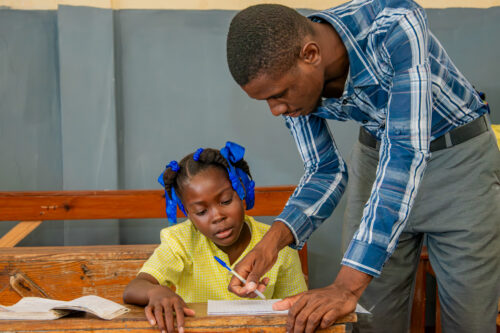 Utilizing this funding, Hope for Haiti will lead a robust teacher training and engagement program across 21 primary schools. Over the grant period, teachers and educators will complete training in academic subjects, classroom management, and gender equity. Monthly training sessions, school break workshops, and summer professional development will support continuous learning. Public health education will also be incorporated into classrooms and community spaces to help improve health outcomes.
To strengthen long-term economic stability, Hope for Haiti will implement financial literacy, entrepreneurship, and life skills training for students and parents. Additionally, new woman-led Village Savings and Loan Associations (VSLAs) will be established. These efforts are designed to improve household financial resilience, reduce absenteeism, and support school sustainability.
“At the W.K. Kellogg Foundation, we know that lasting change must be driven by communities themselves,” said Alix Cantave, Senior Program Officer at the W.K. Kellogg Foundation. “Hope for Haiti’s work provides tools to Haitian leaders so they can advance quality education, strengthen family well-being, and build economic resilience. We are proud to support their community-centered efforts to expand opportunity for children and families across southern Haiti.”
The project will focus on communities in Haiti’s Sud, Sud-Est, and Nippes Departments, primarily in rural areas outside Port-au-Prince, where educational and health resources are more limited. In total, the initiative aims to improve the quality of affordable education at 21 partner schools, supporting approximately 241 teachers who educate 7,490 students.
This grant builds on the W.K. Kellogg Foundation’s previous investments in Hope for Haiti’s integrated programs in education, health, economic development, and infrastructure. Prior support strengthened learning environments across 21 partner schools, benefiting thousands of students through expanded health services, teacher training, academic resources, and improved facilities.
###
About Hope for Haiti
With experience running poverty alleviation programs in Haiti since 1989, Hope for Haiti has emerged as one of the most trusted non-profit organizations working to improve the quality of life for the Haitian people, particularly women and children, in southern Haiti. The organization’s team and network of partners provide people with better access to education, healthcare, clean water, and economic development opportunities. Hope for Haiti is a 4-star-rated charity by Charity Navigator and is a participant at the Platinum Level in the GuideStar Exchange, two leading independent evaluators recognizing the organization’s transparency and careful stewardship of donor resources. Learn more at hopeforhaiti.com.
About the W.K. Kellogg Foundation
The W.K. Kellogg Foundation (WKKF), founded in 1930 as an independent, private foundation by breakfast cereal innovator and entrepreneur Will Keith Kellogg, is among the largest philanthropic foundations in the United States. Guided by the belief that all children should have an equal opportunity to thrive, WKKF works with communities to create conditions for vulnerable children so they can realize their full potential in school, work and life.
The Kellogg Foundation is based in Battle Creek, Michigan, and works throughout the United States and internationally, as well as with sovereign tribes. Special attention is paid to priority places where there are high concentrations of poverty and where children face significant barriers to success. WKKF priority places in the U.S. are in Michigan, Mississippi, New Mexico and New Orleans; and internationally, are in Mexico and Haiti. For more information, visit www.wkkf.org.