FAQs last updated September 2026. Specific facts and figures should be reconfirmed against Hope for Haiti’s latest annual report and financial filings. Have more questions? Please email us at info@hopeforhaiti.com.
Frequently Asked Questions
Our team often receives questions about our work in Haiti and how it has been affected by the challenges in the country. Here are honest answers to the questions we hear most often from people who want to understand Haiti, our approach, and the impact their generosity makes.
Frequently Asked Questions
Haiti Today
Everything I hear about Haiti in the news sounds dire — gang violence, political instability, poverty. Is there really reason for hope?
We understand why it looks that way from the headlines, and we won’t pretend the crisis is anything less than serious: violence by armed groups, displacement, and a fragile transitional government have upended daily life for millions of Haitians. However, it is important to understand that the violence and displacement are concentrated in Haiti’s capital city, Port-au-Prince. While insecurity has blocked transport in the larger metropolitan area, the majority of Haiti continues to function despite the ongoing crisis.
What rarely makes the news is what we see every day — teachers who keep showing up to teach, nurses who keep showing up to care for patients, parents who keep finding ways to get their kids to school. There are also real, if fragile, signs of forward motion. Progress is rarely a straight line, but the Haitian people’s tenacity is the most consistent thing we’ve witnessed in over three decades of working alongside them. That’s where our hope comes from — not from looking away from the hard parts, but from seeing what continues despite them.
What about corruption? I’ve heard that’s a major problem in Haiti.
Governance challenges are real and well documented, and we think donors are right to ask about them — both in Haiti and in the organizations working there. Our answer is to be as transparent about our own operations as we’re asking others to be: our finances are independently audited every year and, along with our Form 990s, are posted publicly. We maintain a large in-country team and our own warehouse so that resources move directly from our hands to the clinics, schools, and families we serve, rather than through layers of intermediaries. We also work closely with Haitian-led organizations and community leaders who know their own communities best. None of that makes Haiti’s broader governance challenges disappear, but it’s how we make sure your generosity reaches the people it’s intended for.
Are the Haitian people doing what they can to build a better future? How about the current Haitian government?
Yes. Haitian families, local leaders, and Haitian civil society are doing an enormous amount with very little — running schools, keeping small businesses alive, organizing community savings groups, and rebuilding after setbacks that would stop many systems entirely. Haiti’s transitional government is working toward national elections, its first since 2021, alongside newly formed security and judicial efforts aimed at restoring order and accountability. We’re careful not to speak on behalf of Haiti’s government or its politics — that’s not our role. What we can say with confidence, from 37+ years working in Haiti, is that the determination of the Haitian people is not in question.
Is it still possible, or safe, for Hope for Haiti to operate given the current crisis?
Yes. Our programs are based in southern Haiti, and our program staff — all of whom are Haitian and live in the communities with whom we partner — are empowered to make daily decisions about where and how we can safely operate. When conditions require it, we adapt: shifting logistics routes, adjusting program delivery, or scaling up emergency response. What hasn’t changed is our commitment to staying. Leaving is often the easiest choice for outside organizations during a crisis; we believe showing up consistently, especially when things are hard, is what real partnership looks like.
About Hope for Haiti
What is Hope for Haiti actually trying to accomplish? What do you do, day to day?
Founded in 1989, Hope for Haiti partners with communities in southern Haiti to improve quality of life through four core program areas: education, healthcare, clean water, and economic development. Concretely, that means supporting schools with material resources and teachers with professional development, running a primary care clinic and public health outreach, providing access to clean water and education about basic hygiene and sanitation, and helping families build sustainable income through savings groups and small-business support. Our goal isn’t to do things for Haitian communities — it’s to invest in the people, systems, and infrastructure that let those communities thrive on their own terms.
What’s your long-term vision for Hope for Haiti, and for Haiti itself?
Our vision is straightforward: joyful children, healthy families, thriving communities, and the resources to make it so. We measure long-term success not by how long we’re needed, but by how strong local systems, schools, clinics, and economies become. A stronger Haiti, led by Haitians, is the goal, and our role is to be a steady, trusted partner on the way there.
How do you know you’re actually making a difference? How do you measure impact?
We track outcomes across each program area — things like the number of teachers trained and the academic progress of their students, medical and dental consultations delivered, families who’ve gained access to clean water or been trained in how to prevent waterborne illness, and households strengthening their income through our economic development programs. For example, in the 2026 fiscal year, students enrolled in our partner schools saw exam passing rates far above national averages.
We report on this data in our published annual reports. We also build in regular monitoring and feedback from the communities we serve (thanks to our Monitoring, Evaluation, Accountability, and Learning [MEAL] team), because the people closest to a problem are usually the best judges of whether a solution is actually working.
Our Programs
A lot of what I hear about aid organizations involves supplies stuck in warehouses or lost to bureaucracy. How is Hope for Haiti different?
This is a real risk in humanitarian work, and it’s one we’ve built our model specifically to avoid. We operate our own distribution center and logistics network in Haiti, staffed by our own team, so that medical supplies, educational materials, and other resources move directly to the clinics, schools, and families that need them — not through a long chain of intermediaries. Because we’re a Haiti-only organization with decades of on-the-ground relationships, we can move quickly and reliably even when broader conditions are difficult.
Who actually carries out your programs in Haiti — your own staff, or outside contractors?
Our own staff. Hope for Haiti employs a team of approximately 100 people, the vast majority of them Haitian (91% as of August 2026), including our Chief Program Officer and Deputy Country Manager. This isn’t incidental — it’s central to how we work. Haitian team members bring language, relationships, and lived understanding that no outside contractor could replicate, and it means the people making day-to-day decisions about our programs are the people most affected by their success.
Do you partner with other organizations? How has that gone?
Yes. Partnership is a critical part of how we work. We believe that sustainable, effective programming requires collaboration rather than organizations working in isolation or duplicating efforts.
Over the years, Hope for Haiti has partnered with organizations including UNICEF, the Clara Lionel Foundation, the W.K. Kellogg Foundation, P4H Global, the Dalio Foundation, and others. Just as importantly, we work closely with Haitian government ministries and departmental authorities, local organizations, healthcare facilities, schools, community leaders, and other humanitarian and development partners.
These partnerships have allowed us to combine resources, technical expertise, and local knowledge; strengthen coordination; and expand the reach and quality of our programs. This is particularly important during emergencies, when strong relationships and coordination can help organizations respond more quickly and ensure assistance reaches communities where it is most needed.
Trust & Accountability
How much of my donation actually goes toward programs in Haiti, versus overhead?
We operate deliberately to keep overhead low so that the vast majority of every dollar goes directly to the people we serve. In fiscal year 2025, 86% of Hope for Haiti’s total expenditures supported program services, and over the past five years, this program ratio has consistently stayed above 86%. This consistency reflects a strategic commitment to maximizing impact for those we serve, not a one-time result. You can review exactly how funds are used in our independently audited financial statements and IRS Form 990s, publicly available for every fiscal year back to 2010, at hopeforhaiti.com/financials.
Who leads Hope for Haiti, and what are their qualifications?
Hope for Haiti operates through a distributed leadership model grounded in the belief that every staff member is a leader and has an important role to play in advancing our mission. Leadership, decision-making, accountability, and responsibility are shared across the organization, with Haitian staff and leaders playing a central role in shaping and implementing our work.
Hope for Haiti is governed by a Board of Directors, chaired by Dr. Vladimir Mathieu, which provides fiduciary oversight, governance, and strategic guidance to the organization. Day-to-day organizational leadership is led by CEO Skyler Badenoch, working in partnership with a senior leadership team that includes our Chief Operating Officer, Chief Program Officer, Chief Financial Officer, and Chief Development Officer, as well as leaders and teams across Haiti and the United States.
Executive compensation is disclosed in Hope for Haiti’s publicly available Form 990. You can learn more about our Board of Directors and leadership team at hopeforhaiti.com/team.
Do you have a board of directors? Are they independent and active?
Yes. Our board provides independent governance and oversight, including an audit oversight committee that reviews our finances each year. You can view our current board at hopeforhaiti.com/our-board.
Are your financial statements audited? Can I see them?
Yes — every year. Both our independently audited financial statements and our IRS Form 990s are posted publicly on our website (hopeforhaiti.com/financials), going back to 2010, so anyone can review exactly how we manage and allocate funds.
Are you a registered 501(c)(3)? Will my donation be tax-deductible?
Yes. Hope for Haiti is a registered 501(c)(3) public charity (EIN 59-3564329), and donations are tax-deductible to the extent allowed by law.
Do you have a strong rating from independent charity evaluators?
Yes. Hope for Haiti holds a 4-star rating from Charity Navigator — its highest possible rating — with a 99% overall score and perfect marks across every accountability and transparency measure it evaluates. We also hold a Platinum Seal of Transparency from Candid (GuideStar), the highest level available.
Will you share my information with other organizations?
No. We do not sell or share donor information. We handle every donor’s information with confidentiality, and you’re always welcome to opt out of future communications or ask that your information be removed from any list — details are in our published Privacy Policy.
Giving & Getting Involved
What’s the best way to give?
We’re grateful for support in any form. Many of our donors find that monthly giving is an especially powerful way to help, since predictable, recurring support helps us plan ahead and sustain programs like healthcare and education year-round rather than having to adjust month to month. One-time gifts via online donation (including cryptocurrency) or mail, stock, and donor-advised fund contributions, employer matching, and legacy or planned gifts are all welcome too — you can find details on all of these at hopeforhaiti.com/get-involved.
How can I stay informed about Hope for Haiti’s work?
The best ways are our email newsletter (subscribe here), our blog at hopeforhaiti.com/blog, and our social media channels (@hopeforhaiti on everything), where we regularly share updates from our team on the ground in Haiti. We also publish a detailed annual report each year covering our programs, finances, and impact. Our annual reports since 2014 can be accessed at hopeforhaiti.com/annual-reports/.
Besides donating, how else can I get involved?
There are quite a few ways: attend an event like our annual Hike for Haiti, start your own fundraiser, explore corporate or foundation partnership opportunities, or simply help spread the word about our work. Visit hopeforhaiti.com/get-involved for current opportunities.
Join Us in Building Resilient Communities in Haiti
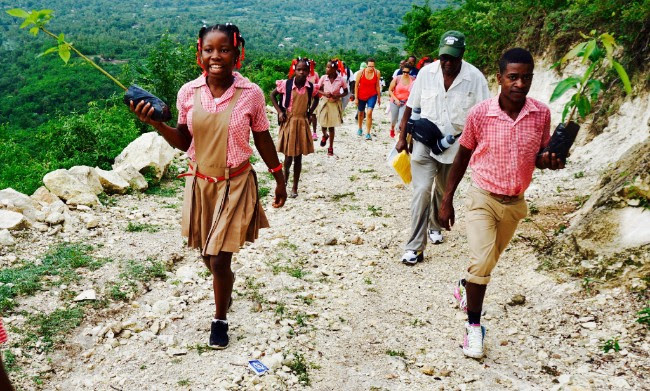
Haiti’s vulnerability to hurricanes and earthquakes makes disaster preparedness and relief essential to creating safe, resilient communities. At Hope for Haiti, we’re committed to ensuring every Haitian family has the knowledge, resources, and support they need to weather any storm. Your support is crucial to this mission. Together, we can continue to safeguard lives and promote recovery in the wake of natural disasters. Join us in building a brighter, more resilient future for Haiti by donating today.
DONATE